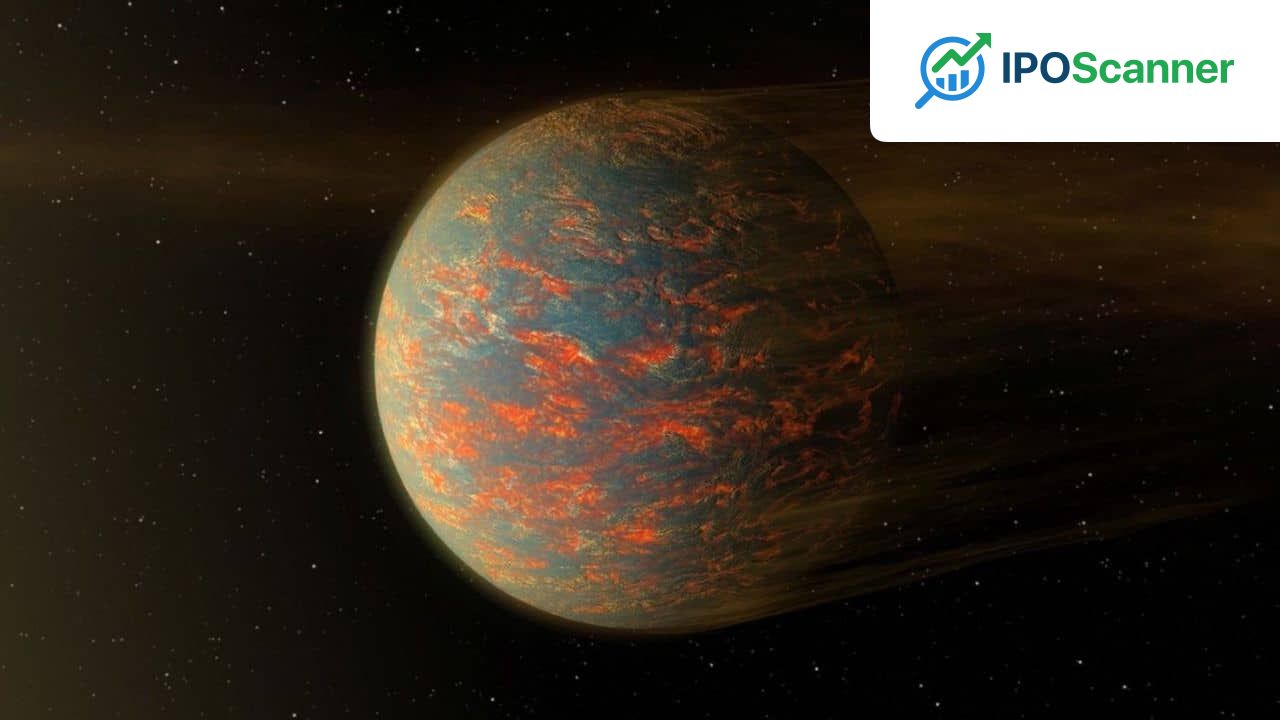
NASA Discovers Exoplanet Potentially Threatening Earth's Ongoing Habitability 48.5 Light Years Away
Historic Breakthrough in Exoplanet Science: James Webb Space Telescope Reveals Details of Distant Rocky Planet LHS 3844 b
Astronomers using the James Webb Space Telescope have made a groundbreaking discovery, directly studying the surface of a distant rocky planet known as LHS 3844 b. Located approximately 48.5 light years from Earth, this planet orbits a small red dwarf star once every 11 hours, making it one of the closest known rocky exoplanets to be examined in such detail.
The findings, published in Nature Astronomy, reveal that LHS 3844 b is tidally locked, meaning one side permanently faces its star while the other remains in darkness. The constant exposure to intense heat has turned the dayside into an extremely hot landscape, with daytime temperatures reaching nearly 725 degrees Celsius. This extreme heat is comparable to that of Mercury or the Moon, rather than Earth.
Using Webb's Mid-Infrared Instrument, scientists measured heat emitted from the planet during several observations when it passed behind its host star. The data suggest that LHS 3844 b has little or no atmosphere. The surface appears to be covered with dark volcanic rock rich in iron and magnesium, likely basalt. Furthermore, the discovery marks the first time astronomers have been able to directly analyze the surface composition of a rocky planet outside the Solar System.
Read also: Kumar Mangalam Birla to Address Concluding Function of RSS Training Camp
| Comparison of Temperatures | LHS 3844 b (Dayside) | Mercury (Dayside) | Moon (Dayside) |
|---|---|---|---|
| Temperature (°C) | 725 | 427 | 127 |
| Temperature (°F) | 1337 | 801 | 261 |
The absence of clear signs of gases such as carbon dioxide or sulphur dioxide indicates that the planet has no volcanic or atmospheric activity. Laura Kreidberg of the Max Planck Institute for Astronomy, who led the observations, notes that the telescope's sensitivity allowed scientists to detect light coming directly from the planet's surface.
The discovery of LHS 3844 b opens a new phase in exoplanet science, where astronomers can move beyond studying atmospheres and begin examining the geology of distant worlds. LHS 3844 b is approximately 30 per cent larger than Earth but far less hospitable due to its extreme heat and lack of atmosphere, making it unable to support life as we know it. However, the planet is considered an important target because it offers clues about how rocky planets form and evolve around red dwarf stars, the most common type of star in the Milky Way.
More in General

Kumar Mangalam Birla to Address Concluding Function of RSS Training Camp

The Cost of Healthcare: Why Predictability in Medical Inflation is Crucial for Health Insurance

Former Google Executive Warns AI Risks Stem from Human Misuse, Not Technological Limitations