AI Detection Tool Raises Questions Over Authenticity of Jawaharlal Nehru's 'Tryst with Destiny' Speech
AI Detection Systems Raise Concerns Over Reliability
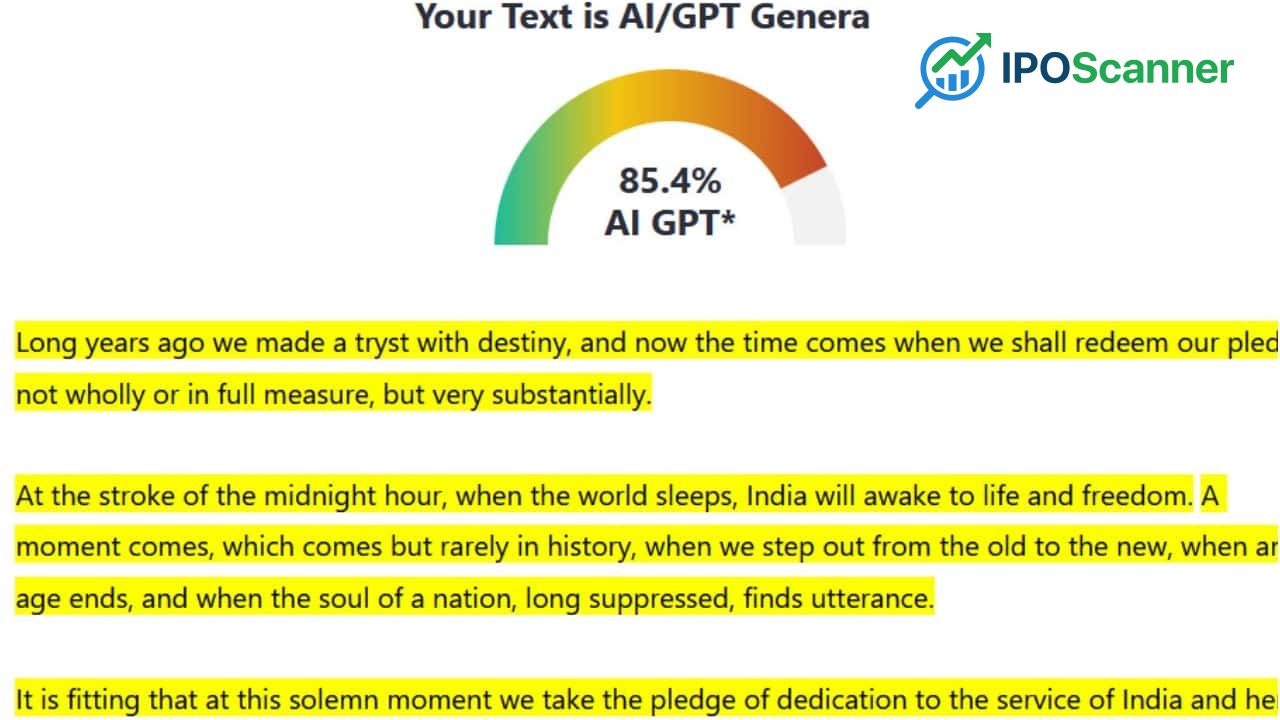
A recent test using ZeroGPT has reignited concerns over the reliability of artificial intelligence detection systems. The test classified a portion of Jawaharlal Nehru's historic 1947 address, "Tryst with Destiny," as AI-generated, despite its well-documented authorship and archival presence.
The flagged passage included lines referring to India's transition to independence and the symbolic "midnight hour." These qualities, recognized for their rhetorical clarity and structured delivery, appeared to have contributed to the misclassification. AI detection tools typically assess writing based on patterns such as consistency, sentence flow, and grammatical precision.
The incident is not isolated, as similar tools have labelled foundational texts, including the United States Constitution, as entirely AI-produced. In a separate test, the Gettysburg Address by Abraham Lincoln was assigned a 96.21% likelihood of AI authorship, further underlining inconsistencies in how these systems evaluate language.
Read also: Indian Space Industry Stocks Gain Momentum: Three Companies to Watch
The debate around AI detection systems has been fueled by a recent LinkedIn post by Yu-kai Chou, who noted that these systems struggle to distinguish between deliberate, well-structured human writing and machine-generated text. Chou observed that the tools appear to prioritize structural patterns over intent, authorship, or historical context.
Most AI detection platforms acknowledge that their assessments are probabilistic rather than definitive. However, in practice, the percentage scores they generate are often treated as conclusive. This has led to wider concerns among writers, educators, and employers, who rely on such tools to evaluate authenticity.
Without contextual awareness, detectors risk misclassifying not only contemporary writing but also historically established material. This highlights the need for a more nuanced approach to AI detection and the importance of considering authorship, intent, and historical context in evaluating language.
Investor Takeaway
Investors should be cautious of relying solely on AI-generated analysis and consider multiple sources for accurate information.
More in General

Indian Space Industry Stocks Gain Momentum: Three Companies to Watch

Kumar Mangalam Birla to Address Concluding Function of RSS Training Camp

The Cost of Healthcare: Why Predictability in Medical Inflation is Crucial for Health Insurance