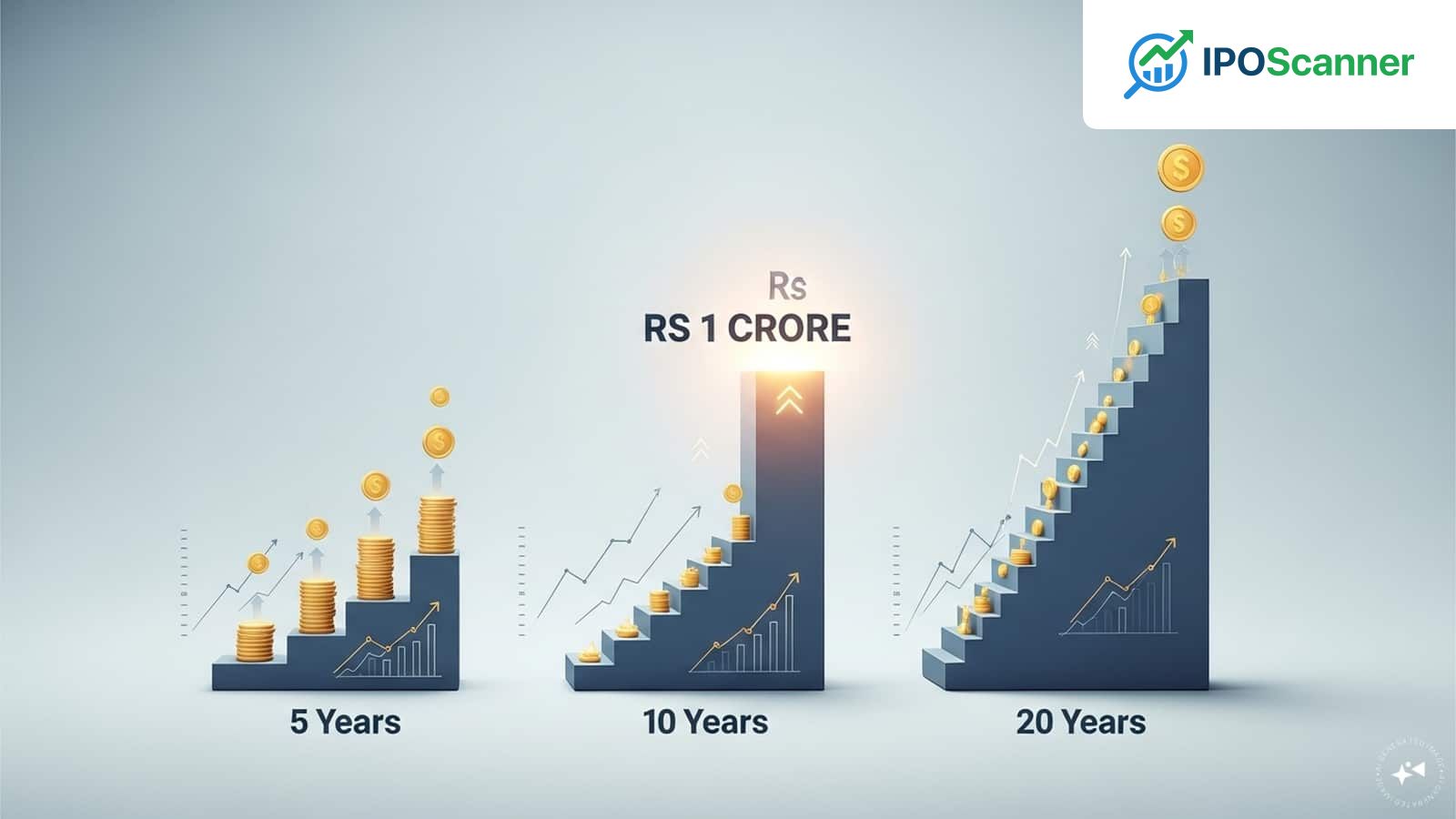
Calculating the Monthly SIP Amount Required to Reach Rs 1 Crore in 5, 10 and 20 Years
The Power of Time in Investing: A Rs 1 Crore Corpus
Investors often assume that building a Rs 1 crore corpus depends on finding the right investment or earning higher returns. However, the reality is that time plays a far more significant role in achieving this goal. The amount needed to invest every month can vary dramatically depending on the investment horizon, with longer timeframes resulting in lower monthly savings requirements.
According to calculations, an investor targeting a Rs 1 crore corpus in five years would need to invest Rs 1,21,232 every month, assuming a 12 percent annualised return. However, stretching the investment horizon to 10 years reduces the required Systematic Investment Plan (SIP) to Rs 43,041, and a 20-year timeline brings it down to just Rs 10,009. This highlights the importance of time in investing, with compounding doing more of the heavy lifting as the investment horizon increases.
The Impact of Time on Investing
Vijay Maheshwari, Founder of Stocktick Capital, notes that the findings reinforce the common investing principle that "time in the market is often more powerful than timing the market." Longer investment horizons give compounding more time to work, resulting in lower monthly savings requirements. For instance, an investor targeting a Rs 1 crore corpus in five years needs to invest more than 12 times the monthly SIP required for a 20-year goal.
| Investment Horizon | Required SIP |
|---|---|
| 5 years | Rs 1,21,232 |
| 10 years | Rs 43,041 |
| 20 years | Rs 10,009 |
The difference becomes even more striking over longer periods. Extending the investment horizon from 20 years to 25 years reduces the SIP required for a Rs 1 crore corpus to just Rs 5,270 per month, almost half the amount needed over 20 years.
The Role of Compounding
Read also: Missing a Single EMI Payment Can Adversely Impact Credit Profile
According to Protima Dhawan, Director, Anand Rathi Wealth Limited, compounding gets more time to work as the investment horizon increases. "Starting early allows compounding to do most of the heavy lifting," she adds. The impact can be seen in how much of the final corpus comes from investment gains rather than fresh contributions.
For example, an investor targeting a Rs 1 crore corpus over 25 years contributes less than Rs 16 lakh but earns more than Rs 84 lakh through investment growth. In contrast, the investor contributes most of the corpus in a five-year example, and compounding plays a much smaller role.
Increasing SIP over Time
For investors who expect their income to rise over the years, increasing SIP contributions periodically can further reduce the starting amount required. For instance, an investor targeting a Rs 1 crore corpus in five years would need a regular SIP of Rs 1,21,232 per month. However, by increasing the SIP by 10 percent every year, the starting SIP requirement falls to around Rs 1,03,200.
| SIP Increase | Required SIP |
|---|---|
| 5 years (no increase) | Rs 1,21,232 |
| 5 years (10% annual increase) | Rs 1,03,200 |
| 10 years (no increase) | Rs 43,041 |
| 10 years (10% annual increase) | Rs 30,600 |
Kirang Gandhi, Director, Kaarmika Wealth Mentors notes that this approach is often more practical than trying to earn significantly higher returns. Contribution growth is within an investor's control, whereas future market returns are not. A step-up SIP also helps investors gradually increase investments as incomes rise.
In conclusion, while returns matter, investors often have greater control over two other variables: time and contribution levels. Starting early and increasing SIPs gradually can significantly reduce the monthly effort needed to reach long-term financial goals such as building a Rs 1 crore corpus.
Investor Takeaway
Investors should consider the time horizon when calculating the monthly SIP amount required to reach their financial goals.
More in General

Correcting Credit Score Errors: A Guide to Ensuring Accurate CIBIL Reports and Optimal Loan Eligibility

Missing a Single EMI Payment Can Adversely Impact Credit Profile

EPF Withdrawal Comes with Tax Implications: A Guide to Understanding the Consequences