South Korea: Samsung Workers' Union Suspends Strike Amid Tentative Pay Agreement
South Korea's Economy Breathes Sigh of Relief as Samsung Strike Averted
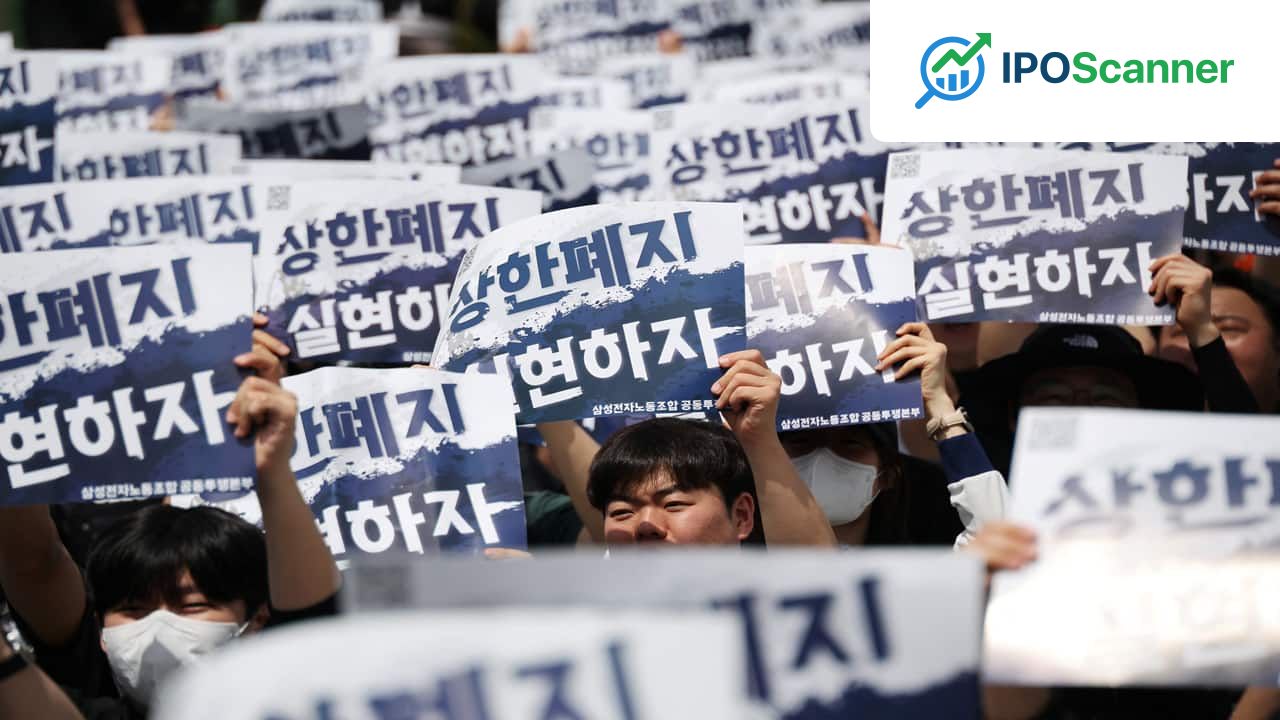
Samsung Electronics' union has announced that it will suspend a planned 18-day strike action, which was set to begin on Thursday, after reaching a tentative pay deal with the company. The strike, which involved nearly 48,000 union members, threatened to disrupt South Korea's economy and global chip supply.
The union members will put the tentative agreement to a vote from May 22 to 27. The deal was reached after days of talks that broke down multiple times, including earlier on Wednesday, before South Korean Labour Minister Kim Young-hoon personally stepped in to mediate.
The key issue that sparked the dispute was the distribution of performance bonuses between Samsung's business units. The union had been pushing for a more equal distribution of bonuses, while the company had wanted to maintain its current system. According to a document shared by the union, Samsung has agreed to set aside about 10.5% of "agreed business performance" for special bonuses for the chip division, which houses its memory and logic chip businesses.
Read also: Treasury Yields Experience Largest Increase in Two Weeks Following Release of Labor Market Data
The special bonuses will be paid in company stock for at least 10 years, with targets for the chip division to achieve more than 200 trillion won ($133.58 billion) in annual operating profit from 2026 to 2028 and 100 trillion won from 2029 to 2035.
| Comparison of Bonus Distribution | | --- | --- | | Current Bonus Distribution | New Bonus Distribution | | 50% cap on bonuses | No cap on bonuses | | Bonuses linked to operating profits | Bonuses linked to operating profits | | Formalization of changes in contracts | Formalization of changes in contracts |
The strike action had the potential to disrupt the global chip supply and fuel price rises at a time when the AI boom has caused shortages. Samsung, which accounts for almost a quarter of South Korea's exports, is also the world's largest memory chip maker.
The South Korean government had flagged that they could order emergency arbitration, a tool that has been rarely employed, to put the strike on hold for 30 days. However, the tentative agreement has averted this possibility, and the government has welcomed the deal.
Read also: US-Iran Tensions Spark Uptick in Oil Prices Amid Global Market Decline
"We are grateful for the broad-minded decision made in the interest of both the country and the public," an official at South Korea's Blue House said. "This outcome was made possible by the efforts of government officials, including the labour minister, who mediated until the end."
The strike had also raised concerns about the impact on the South Korean economy. An official from the country's central bank had forecast that the strike could shave 0.5 percentage points off a forecast 2.0% expansion for the South Korean economy this year.
Samsung shares ended up 0.2% after the news of the tentative agreement, while the company's overall performance remains a concern for investors. Some investors are more worried about the prospects of a permanent spike in labour costs than they are about the one-off costs of the strike.
Investor Takeaway
A tentative pay deal between Samsung and its union may avert a strike that could have impacted the global chip supply.
More in Market

Treasury Yields Experience Largest Increase in Two Weeks Following Release of Labor Market Data

US-Iran Tensions Spark Uptick in Oil Prices Amid Global Market Decline

Indian Stocks to Watch: BHEL, Agarwal Industrial, JBM Auto, Rajesh Exports, Indian Energy Exchange, Lenskart Solutions in Market Focus on June 4.