Oil Ministry Team Investigates Pachpadra Refinery Fire in Rajasthan; HPCL Reports No Material Impact
Fire at HPCL Rajasthan Refinery Contains No Fatalities or Injuries
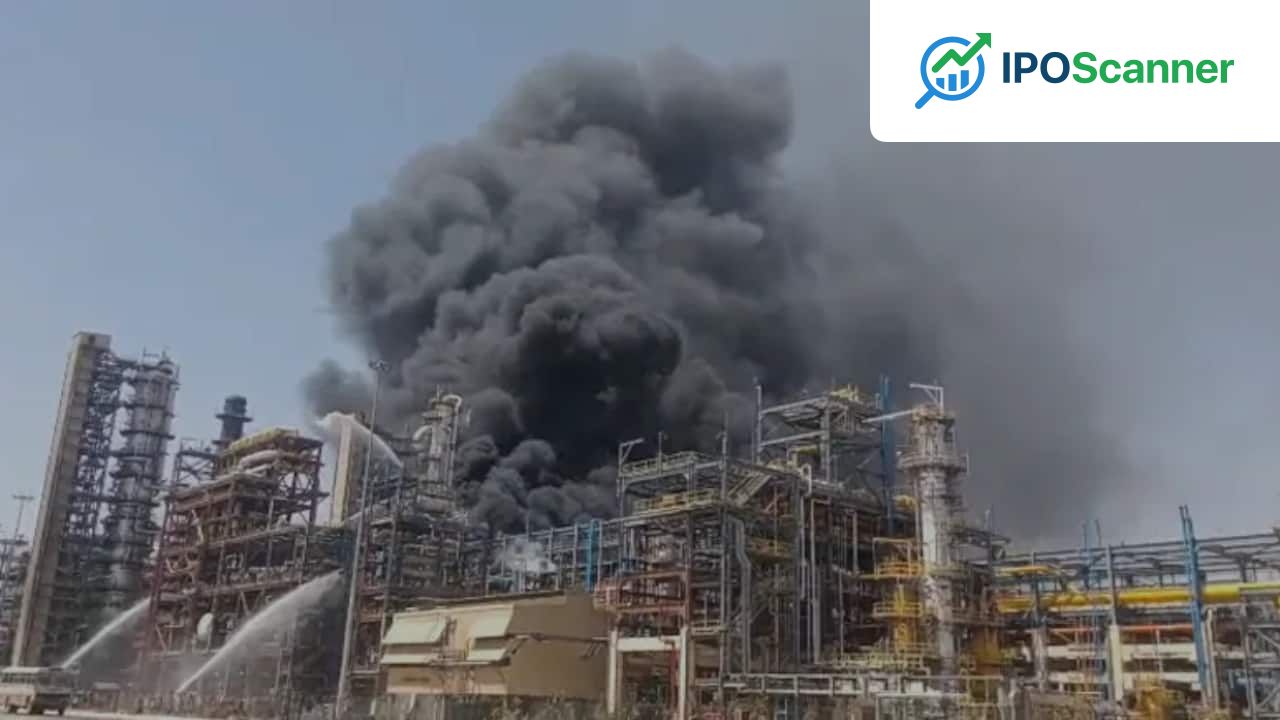
A four-member team constituted by India's oil ministry has arrived in Rajasthan to investigate a fire that broke out at the HPCL Rajasthan Refinery Limited, a joint venture between Hindustan Petroleum Corporation Ltd (HPCL) and the Government of Rajasthan, on April 20. The fire occurred in the crude distillation unit, the main unit of the refinery, and was likely caused by a hydrocarbon leak from a valve or flange in a heat exchanger circuit.
The incident occurred a day before the scheduled inauguration of the refinery by Prime Minister Narendra Modi. The blaze was quickly brought under control by the site's emergency response team, and no casualties or injuries were reported. The crude distillation unit, vacuum distillation unit, and associated sections were isolated as a precaution.
The scheduled dedication of the refinery has been postponed, with a revised date to be announced. The team led by former MRPL managing director M Venkatesh has been tasked to investigate the cause of the incident. The investigating team will assess the delays, if any, in the commissioning timelines once it completes its probe.
Read also: Treasury Yields Experience Largest Increase in Two Weeks Following Release of Labor Market Data
The fire was confined to the heat exchanger stack and was promptly brought under control by the emergency response team of HRRL with support from the local administration. The incident has not affected any other section of the refinery, and all units are structurally safe and unaffected.
The Rajasthan Refinery, valued at Rs 79,450 crore, is a 9 million tonnes per annum facility with a strong petrochemical focus, reflecting India's strategy to boost value-added output and reduce import dependence. The refinery-cum-petrochemical complex is designed to produce fuels, including petrol and diesel, along with petrochemicals such as polypropylene, polyethylene variants, and key industrial chemicals like benzene and butadiene.
The Rajasthan refinery will be India's 24th and the second most complex unit yet in India, featuring a Nelson Complexity Index of 17 and petrochemical yields exceeding 26 per cent, aligning with global benchmarks for efficiency and sustainability.
| Refinery | Complexity Index | Processing Capacity (Barrels per Day) |
|---|---|---|
| HPCL Rajasthan Refinery | 17 | 180,000 |
| Reliance Industries Ltd's Jamnagar Refinery | 21.1 | 1.24-1.4 million |
Read also: US-Iran Tensions Spark Uptick in Oil Prices Amid Global Market Decline
Refineries worldwide are highly susceptible to fires, explosions, and catastrophic failures during the commissioning and startup phases, as this period involves introducing hydrocarbons into new or maintained high-pressure, high-temperature systems. The inauguration ceremonies are performed after all units are safely commissioned and operations stabilized.
This is not the first time a fire has broken out at a refinery under commissioning. On January 30, 2016, a major fire broke out at Indian Oil Corporation's (IOC) Paradip refinery's atmospheric vacuum unit (AVU), just over a week before its scheduled inauguration by Prime Minister Modi on February 7, 2016. No injuries were reported even then.
The Rajasthan refinery is a joint venture between HPCL, which holds a 74 per cent stake, and the Government of Rajasthan with the remaining 26 per cent.
More in Economy

Treasury Yields Experience Largest Increase in Two Weeks Following Release of Labor Market Data

US-Iran Tensions Spark Uptick in Oil Prices Amid Global Market Decline

MoSPI Releases Uniform Norms for DDP Estimates with 2022-23 Base Year

