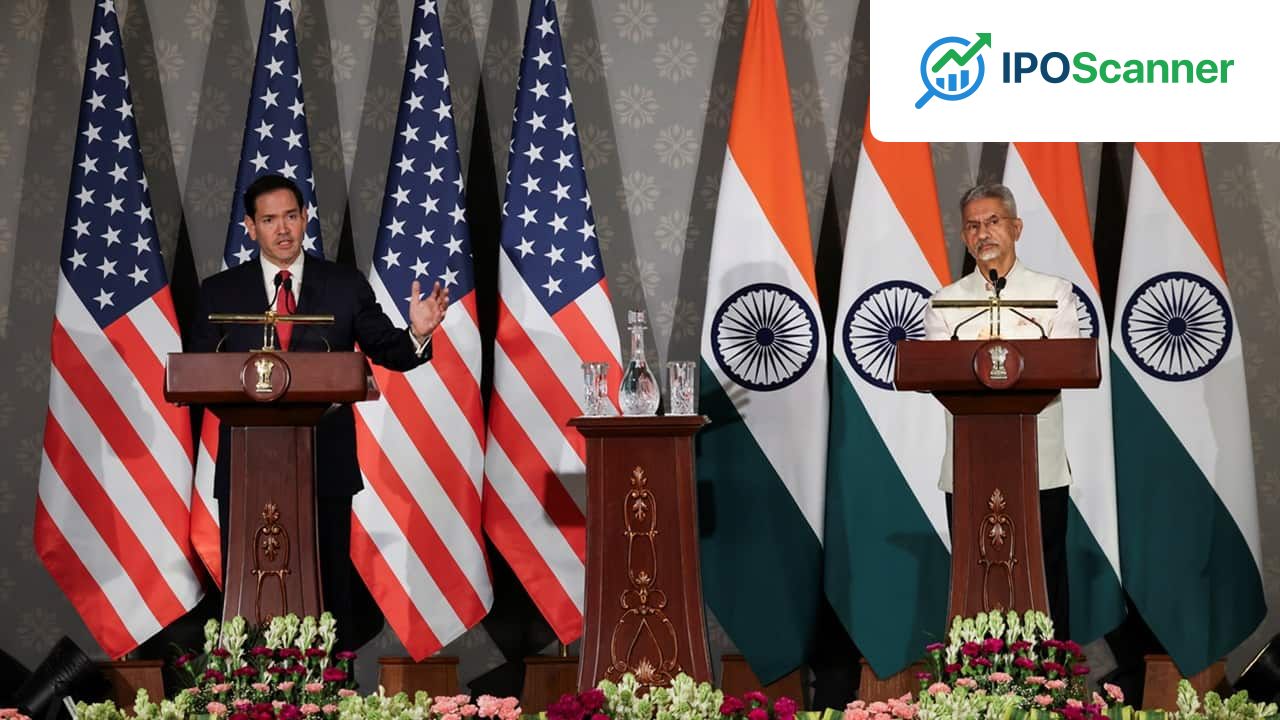
India's EAM Jaishankar Conveys Five-Point Trade Message to US Senator Rubio
India Outlines Five-Point Approach to Global Issues During US Secretary of State Marco Rubio's Visit
External Affairs Minister S. Jaishankar outlined India's five-point approach to major regional and global issues during delegation-level talks with US Secretary of State Marco Rubio on Sunday. The talks, held at Hyderabad House in New Delhi, highlighted India's support for diplomacy, uninterrupted maritime commerce, resilient supply chains, and opposition to the weaponisation of trade and resources.
Jaishankar stated that India and the United States remain in regular strategic coordination across trade, defence, energy, and geopolitical issues. This is the Secretary's first visit to India, but ever since he assumed office, the two nations have been in regular touch. They have had a continuous engagement that has facilitated their overseeing the broad-based and growing cooperation between their two nations.
India's Five-Point Global Position
Read also: Treasury Yields Experience Largest Increase in Two Weeks Following Release of Labor Market Data
Jaishankar used the briefing to formally articulate India's broad approach to current geopolitical and economic disruptions. He stated that India advocates dialogue and diplomacy to address conflicts, supports safe and unimpeded maritime commerce, demands scrupulous respect for international law, is against the weaponisation of market shares and resources, and believes in the value of trusted partnerships and resilient supply chains to de-risk the global economy.
| Issue | India's Position |
|---|---|
| Conflict Resolution | Dialogue and Diplomacy |
| Maritime Commerce | Safe and Unimpeded |
| International Law | Scrupulous Respect |
| Resource Management | Against Weaponisation |
| Supply Chain Resilience | Trusted Partnerships and Resilient Supply Chains |
The comments come as disruptions linked to the Strait of Hormuz continue to remain a major concern for global energy markets and shipping routes. India imports a substantial portion of its crude oil through West Asian maritime corridors, making energy security and shipping access central to its diplomatic positioning.
Gulf Tensions and Iran Discussions Featured Prominently
Read also: US-Iran Tensions Spark Uptick in Oil Prices Amid Global Market Decline
Jaishankar said discussions with Rubio covered developments in West Asia, the Indian subcontinent, East Asia, and the upcoming Quad ministerial meeting scheduled for May 26. The talks also focused on the latest developments in the Gulf and the Ukraine conflict.
Rubio separately indicated that progress may have been made in negotiations involving Iran and the Strait of Hormuz. He stated that a possible agreement could address US concerns over the Strait of Hormuz and contribute toward limiting Iran's nuclear capabilities.
India-US Trade Talks Gain Momentum
The two sides also discussed efforts to conclude the proposed India-US interim trade agreement, which is expected to serve as a stepping stone toward a broader bilateral trade pact discussed during Prime Minister Narendra Modi's Washington visit in February 2025. Jaishankar stated that the two nations spoke about the value of concluding the final text of the interim agreement at an early date, regarding reciprocal and mutually beneficial trade.
India and the United States have accelerated trade discussions over the past year as both countries seek to strengthen supply-chain resilience, deepen strategic economic ties, and reduce overdependence on concentrated manufacturing networks.
Energy Security and Nuclear Cooperation Discussed
Jaishankar said energy cooperation formed a key part of the discussions, describing affordable and diversified energy access as a core priority for India. He stated that ensuring the accessibility and affordability of energy for 1.4 billion people is India's prime objective, and diversified supplies are at the heart of energy security for India.
He also referred to the recently passed Shanti Act, saying it had opened fresh possibilities for India-US nuclear cooperation. According to Jaishankar, an American delegation had recently visited India and discussions were ongoing regarding regulatory issues related to nuclear collaboration.
Defence, Critical Minerals, and AI Remain Focus Areas
On defence cooperation, Jaishankar referred to the renewed 10-year India-US major defence partnership framework and the signing of a comprehensive underwater domain awareness roadmap. He stated that the two nations discussed the importance of taking into account the 'Make in India' approach and lessons drawn from recent conflicts while going forward in the defence domain.
India and the United States have steadily expanded defence cooperation over the past decade through logistics agreements, technology-sharing initiatives, joint military exercises, and Indo-Pacific maritime coordination.
Counter-Terror Cooperation Remains Part of Strategic Engagement
The External Affairs Minister also underlined continued cooperation between Indian and US agencies on counter-terror efforts and narcotics enforcement. Jaishankar stated that India's position in that regard is very clear, and it is one of zero tolerance.
More in Economy

Treasury Yields Experience Largest Increase in Two Weeks Following Release of Labor Market Data

US-Iran Tensions Spark Uptick in Oil Prices Amid Global Market Decline

MoSPI Releases Uniform Norms for DDP Estimates with 2022-23 Base Year

