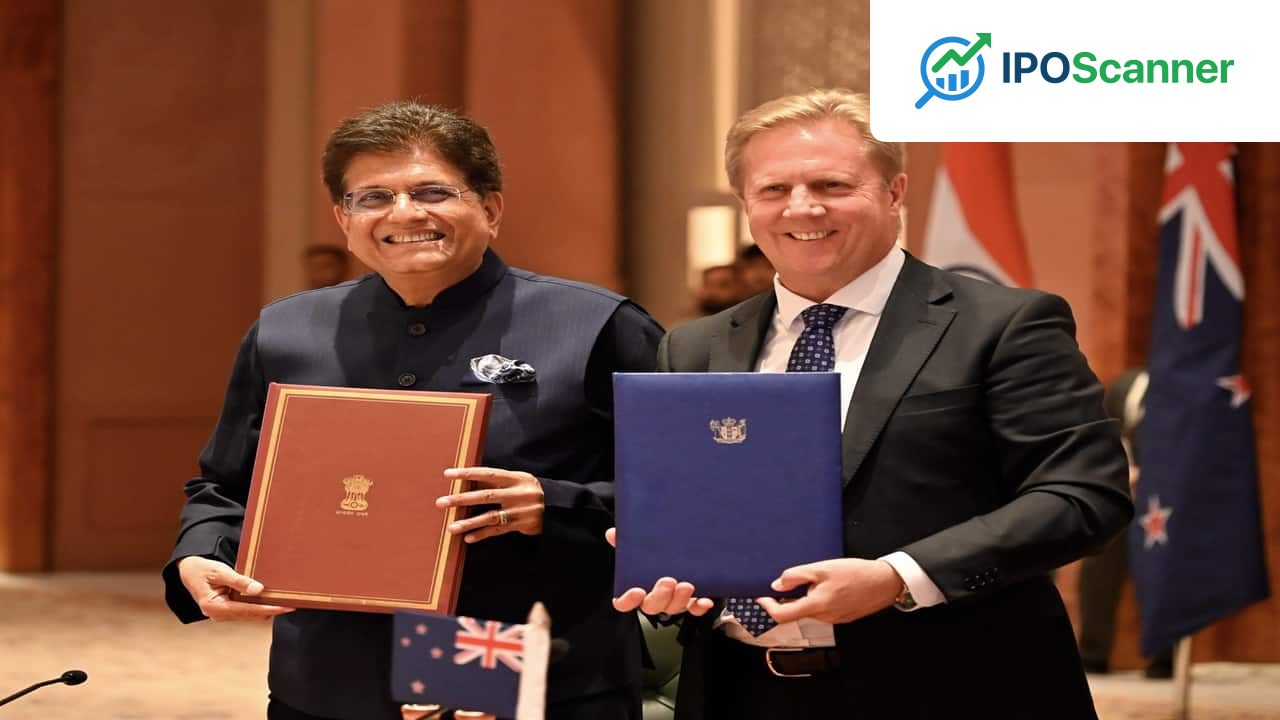
India Signs Landmark Free Trade Agreement with New Zealand, Expanding Existing International Trade Partnerships
India Signs Landmark Free Trade Agreement with New Zealand, Expanding Global Reach
On Monday, India signed a landmark free trade agreement with New Zealand, a deal that both sides say could redefine economic ties by unlocking trade, investment, and talent mobility. The agreement, which is among India's fastest to be negotiated and signed, marks a significant milestone in India's rapidly expanding network of free trade agreements.
Prime Minister Narendra Modi Describes the Deal as a "Landmark Moment"
The deal includes tariff cuts, a $20 billion investment commitment over 15 years, and expanded mobility for students and skilled workers. Prime Minister Narendra Modi called it a "landmark moment," saying it would "add unprecedented momentum" to bilateral ties and benefit farmers, MSMEs, startups, and professionals.
Read also: Treasury Yields Experience Largest Increase in Two Weeks Following Release of Labor Market Data
India's Growing FTA Network
India's modern FTA push began with Mauritius in 2021, marking its first such agreement in Africa. The CECPA opened access for hundreds of Indian products and over 100 services sectors, laying the foundation for a more outward-looking trade policy.
| FTA Partner | Signed | Key Benefits |
|---|---|---|
| Mauritius | 2021 | Access for 100s of Indian products, 100+ services sectors |
| United Arab Emirates | 2022 | Bilateral trade crossed $100 billion, non-oil exports surged |
| Australia | 2022 | 100% of Australian tariff lines open to Indian exports, deepened cooperation in services |
| European Free Trade Association | 2023 | $100 billion investment commitments, focus on job creation |
| United Kingdom | 2025 | Duty-free access to nearly all Indian exports, eased mobility for professionals |
| Oman | 2025 | Near-total market access for Indian goods, opened doors for services and traditional medicine sectors |
| European Union | 2026 | 97% of EU tariff lines open, 144 services sub-sectors |
The newly signed deal with New Zealand now extends India's reach into the Pacific, offering zero-duty access on many products and positioning India as a supplier of skilled talent across sectors.
Read also: US-Iran Tensions Spark Uptick in Oil Prices Amid Global Market Decline
What This Means for India
According to the Ministry of Commerce, these agreements reflect "a decisive and confident India, redrawing the map of global trade." The strategy combines aggressive market access with protection of sensitive sectors like dairy and agriculture.
The benefits span multiple layers.
- Farmers gain access to developed markets for products like tea, coffee, and spices.
- MSMEs and labour-intensive sectors such as textiles, leather, and gems become more competitive as tariffs fall.
- Services exports, from IT to education, get new growth avenues, while professionals benefit from easier mobility and visa pathways.
- India is using FTAs to attract long-term investment and integrate into global value chains, while maintaining what it calls a "calibrated approach" to protect domestic industries.
India's FTA expansion is far from over.
Negotiations are underway or advancing with partners like the U.S., Israel, Gulf Cooperation Council, Canada, and Mexico, alongside a review of the ASEAN trade pact. Together, these moves signal a clear shift - India is positioning itself not just as a participant, but as a central player in shaping global trade flows.
Investor Takeaway
India's expanding free trade agreements network may positively impact its integration with global markets.
More in Economy

Treasury Yields Experience Largest Increase in Two Weeks Following Release of Labor Market Data

US-Iran Tensions Spark Uptick in Oil Prices Amid Global Market Decline

MoSPI Releases Uniform Norms for DDP Estimates with 2022-23 Base Year

