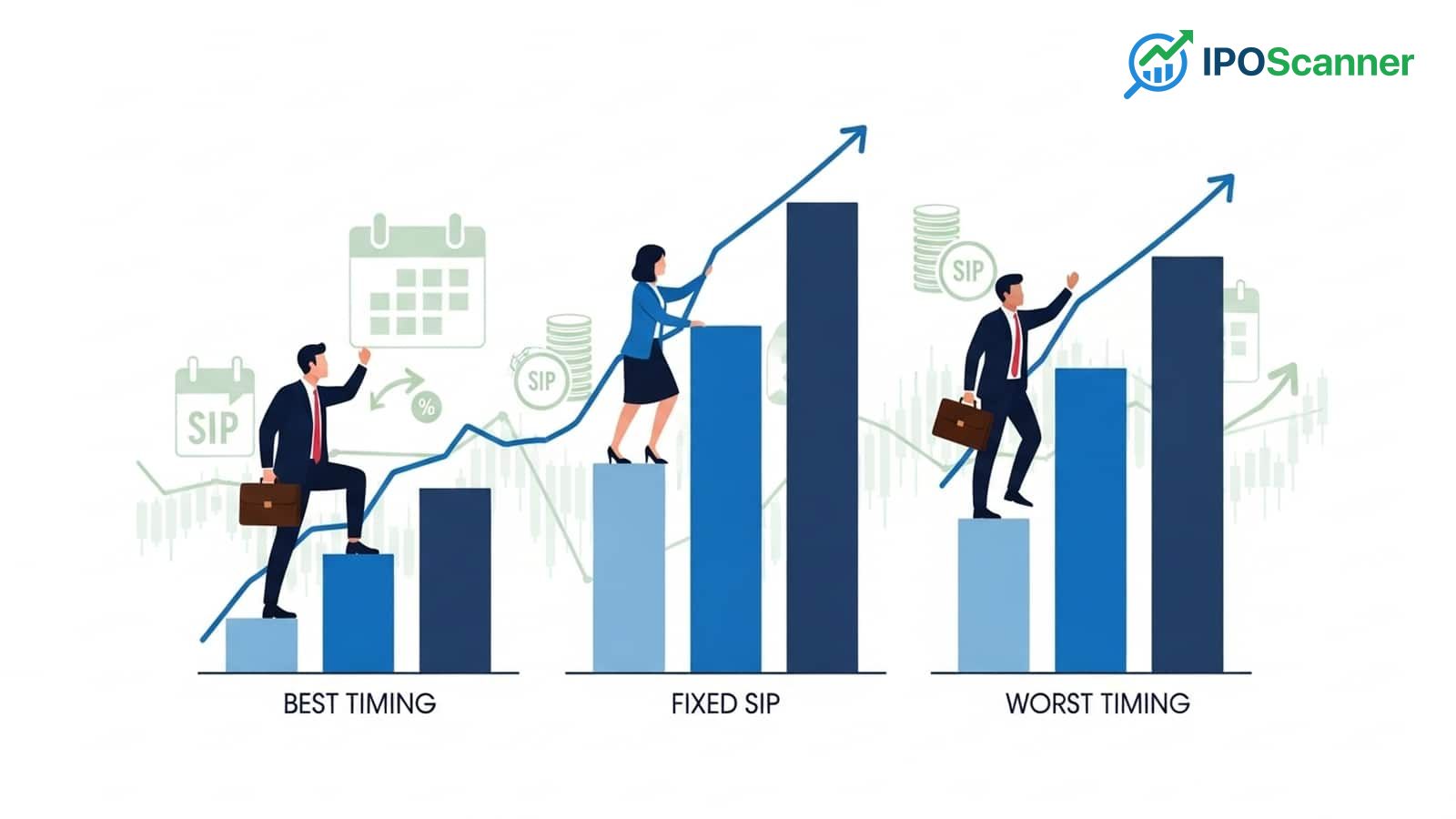
Impact of SIP Date Changes on Investment Returns Over 30 Years
Market Volatility's Impact on SIP Investments: A Surprisingly Small Gap
Market volatility often triggers a dilemma for SIP investors: should they pause investments, wait for a correction, or shift the SIP date to optimize returns? Many believe that choosing the right day of the month or avoiding volatile phases can significantly improve long-term performance. However, a nearly 30-year analysis of SIP investments in the BSE Sensex TRI suggests that the impact of timing may be far smaller than most investors imagine.
A 30-Year Analysis of SIP Investments
WhiteOak Mutual Fund analyzed SIP returns across different monthly investment dates between August 1996 and April 2026 in the BSE Sensex TRI. The results showed that the gap between perfect timing and the worst timing was surprisingly small.
Read also: Treasury Yields Experience Largest Increase in Two Weeks Following Release of Labor Market Data
| Investment Date | Extended Internal Rate of Return (XIRR) |
|---|---|
| Best Possible Day | 13.80% |
| Worst Possible Day | 13.32% |
| Fixed Date | 13.58% |
As seen in the table above, an investor who invested on the best possible day every month generated a 13.80 percent Extended Internal Rate of Return (XIRR) over the period. Meanwhile, an investor who consistently invested on the worst possible day every month still earned 13.32 percent, a difference of just 0.48 percentage points between perfect timing and the worst timing.
Returns Remain Similar Across Different SIP Dates
The report also looked at the SIP returns across different dates of the month. The numbers barely moved, with returns staying remarkably similar regardless of whether investments were made at the beginning, middle, or end of the month.
Read also: US-Iran Tensions Spark Uptick in Oil Prices Amid Global Market Decline
| SIP Date | Extended Internal Rate of Return (XIRR) |
|---|---|
| 1st | 13.59% |
| 10th | 13.55% |
| 20th | 13.58% |
| 28th | 13.61% |
As seen in the table above, SIPs invested on the 1st of every month delivered a 13.59 percent return, while investments made on the 10th generated 13.55 percent. SIPs on the 20th returned 13.58 percent and those invested on the 28th delivered 13.61 percent. Across most dates, returns stayed within a narrow range of around 13.55 percent to 13.61 percent.
Key Takeaways for Investors
The findings suggest that long-term SIP outcomes remained broadly similar across different investment timings over the nearly three-decade period studied. Whether investments were made on the "best" day, the "worst" day, or simply on a fixed monthly date, the return differences remained limited. In fact, the gap between the "best" and "worst" was less than half a percentage point over nearly 30 years. The data also showed that investors who simply stayed disciplined with a fixed monthly SIP came very close to matching the returns generated through perfect timing.
Investor Takeaway
Timing may have a smaller impact on long-term SIP investment returns than previously thought.
More in Market

Treasury Yields Experience Largest Increase in Two Weeks Following Release of Labor Market Data

US-Iran Tensions Spark Uptick in Oil Prices Amid Global Market Decline

Indian Stocks to Watch: BHEL, Agarwal Industrial, JBM Auto, Rajesh Exports, Indian Energy Exchange, Lenskart Solutions in Market Focus on June 4.